
Curso: Contabilidad Básica para la Toma de Decisiones
📅 Fecha de Inicio: 25/05/2026
🕒 Horario: Lunes, de 18:00 a 22:00 horas
⌛ Duración: 25 horas
Inscripción
Contáctanos
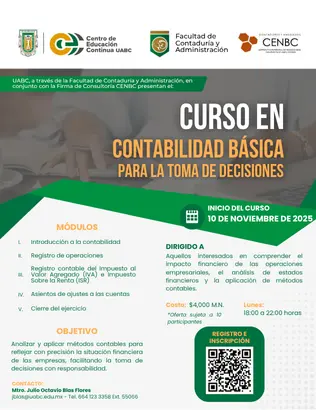
UABC, a través de la Facultad de Contaduría y Administración, en conjunto con la Firma de Consultoría CENBC presentan el Curso en Contabilidad Básica para la Toma de Decisiones
Objetivo
Razonar, ejecutar y comprender las repercusiones contables en la situación financiera de las empresas por las operaciones que practican y las que influyen también de manera externa, conociendo y aplicando los métodos y procedimientos contables para conocer los resultados de operación elaborando los estados financieros que reflejen la realidad económico financiera de forma comprometida y responsable que servirán de base para la toma de decisiones.
Al finalizar los participantes:
- 1. Conocerán con certeza las áreas de la CONTADURIA.
- 2. Podrán ubicar a la Contabilidad dentro de la CONTADURIA.
- 3. Conocimiento pleno de que la CONTABILIDAD auxilia al PROCESO ADMINISTRATIVO de las empresas.
- 4. Comprensión de las afectaciones en la situación financiera de las empresas por las operaciones que realizan.
- 5. Conocerán cuales son los informes contables internos y externos obligatorios de acuerdo a las leyes fiscales en México.
- 6. Formulación de los Estados financieros desde el inicio o constitución de las empresas.
- 7. Adquirir la razonabilidad de la elaboración de los Estados financieros básicos como son: El balance general, el Estado de resultados, Estado de flujo de efectivo y el Estado de cambios en las cuentas del capital contable, emitiendo juicios constructivos y razonables para la toma de decisiones.
Dirigido a
Aquellos interesados en comprender el impacto financiero de las operaciones empresariales, el análisis de estados financieros y la aplicación de métodos contables.
Contenido
Módulo 1: Introducción a la contabilidad
- Definición de contabilidad según el Instituto Mexicano de Contadores Públicos.
- Ubicación de la contabilidad en la CONTADURIA.
- Obligaciones internas y externas de registrar las operaciones que practican las empresas.
- La Ecuación Contable.
- Principios contables o Normas de información contable.
- Estados financieros básicos: Balance general, Estado de resultados, Estado de flujo de efectivo y Estado de cambios en cuentas de capital contable.
Módulo 2: Registro de operaciones
- Concepto de cuenta.
- Clasificación de las cuentas.
- Partes o contenidos de las cuentas.
- Partida doble.
- Registros o asientos contables afectando a la ECUACION.
- Emitir juicios o criterios para la correcta interpretación del porqué las cuentas o registros contables afectan a la ecuación contable y porque siempre se conserva el equilibrio entre el total del Activo y la suma del Pasivo más el Capital contable.
Módulo 3: Registro contable del Impuesto al Valor Agregado (IVA) e Impuesto Sobre la Renta (ISR)
- Fundamentos legales de acuerdo a la Ley del IVA y la Ley del ISR vigentes.
- Registro contable en compras de mercancías y gastos incurridos (egresos) gravados por las ley del IVA e ISR.
- Registro contable en ventas de mercancías y otros ingresos gravados por la Ley del IVA.
- Registro contable del Impuesto sobre la renta.
Módulo 4: Asientos de ajustes a las cuentas
- Ajustes a las cuentas de ACTIVO, PASIVO Y CAPITAL CONTABLE.
- Elaboración de la BALANZA DE COMPROBACION.
Módulo 5: Cierre del ejercicio
- Ajustes, estimaciones y correcciones a las cuentas.
- Conciliaciones de las cuentas (bancos, clientes, proveedores, etc.)
- Cierre de las cuentas que afectan los resultados de operación (Ingresos y Egresos).
- Preparación de documentos relevantes.
- A partir de la BALANZA DE COMPROBACION ya revisada y actualizada, se elaborarán los ESTADOS FINANCIEROS BASICOS Y SECUNDARIOS.
Intructores
C.P. Ramón Hernández Wence